

7 RAG Mistakes Developers Make (And How to Fix Them)

Building a Retrieval-Augmented Generation (RAG) pipeline sounds straightforward on paper — until your production chatbot begins hallucinating outdated facts, dropping crucial paragraphs, or drowning your LLM in irrelevant noise. If you’ve shipped a RAG system that feels “almost right” in development but continuously misses the mark with real users, you are not alone.
Most naive RAG implementations rely on a generic tutorial pattern: dump raw documents into a vector database, perform standard cosine similarity search on the top-5 chunks, and feed them into GPT-4 or Claude. In production environments with enterprise documentation, technical API specs, and long-tail domain queries, this simplistic approach breaks down rapidly.
Key Takeaway: High-performance RAG is not about having a bigger context window; it is about maximizing semantic precision through intelligent chunking, hybrid retrieval, neural reranking, and continuous observability.
Below are the seven critical RAG mistakes engineering teams make in production — and the exact architectural patterns to fix them.
1. Ignoring Chunk Size & Overlap Optimization
The first point of failure in any RAG pipeline happens during the ingestion phase: chunking your source documents.

Why Oversized Chunks Dilute Retrieval Precision
Large chunks (e.g., 2,000+ tokens) might seem safe because they retain broad context. However, when an embedding model condenses 2,000 tokens into a single 1536-dimensional vector, the specific facts get averaged out. When a user asks a highly specific question, the vector similarity score is diluted by surrounding paragraphs, causing your retriever to miss the needle in the haystack.
Why Undersized Chunks Strip Critical Meaning
Conversely, splitting text into 50-token sentences creates disconnected fragments. If sentence A states a condition and sentence B contains the conclusion, retrieving only sentence B leaves your LLM guessing the premise — directly causing hallucinations and vague answers.
Recommended Chunking Baseline Guidelines
| Document Type | Recommended Chunk Size | Overlap % | Splitting Strategy |
|---|---|---|---|
| Technical Docs & APIs | 512 – 768 tokens | 15% – 20% | Markdown Header / Code aware |
| Legal Contracts & Policies | 256 – 512 tokens | 20% | Clause / Paragraph boundaries |
| Conversational Support Logs | 128 – 256 tokens | 10% | Turn-based / Dialogue unit |
| Academic & Research Papers | 512 – 1024 tokens | 15% | Section & Sub-header hierarchy |
The Fix: Implement Recursive Character Splitting or Semantic Chunking with an intentional 15% to 20% token overlap to guarantee that sentences straddling chunk boundaries are never truncated.
2. Using the Wrong Embedding Model for Your Domain
Many developers default to whatever generic embedding API is cheapest or fastest without testing domain alignment. An embedding model optimized for conversational English will struggle with legal terminology, medical literature, or multi-language source repositories.
How to Benchmark Embedding Models
Consult the MTEB (Massive Text Embedding Benchmark) leaderboard, but always run validation on your own dataset. Look at metrics like:
- Domain Similarity Score: How closely vector distances reflect genuine semantic relevance in your niche.
- Embedding Dimensionality: Utilizing models with Matryoshka Representation Learning (MRL) allows you to scale embedding dimensions (e.g., from 1536 down to 512) without losing retrieval fidelity.
- Context Window Support: Ensure your embedding model natively supports your target chunk size without silent truncation.
3. Skipping Neural Cross-Encoder Reranking
Vector databases use Bi-Encoders to compute cosine similarity rapidly across millions of vectors in milliseconds. However, Bi-Encoders compute vectors independently for queries and documents, sacrificing nuanced semantic interaction for speed.
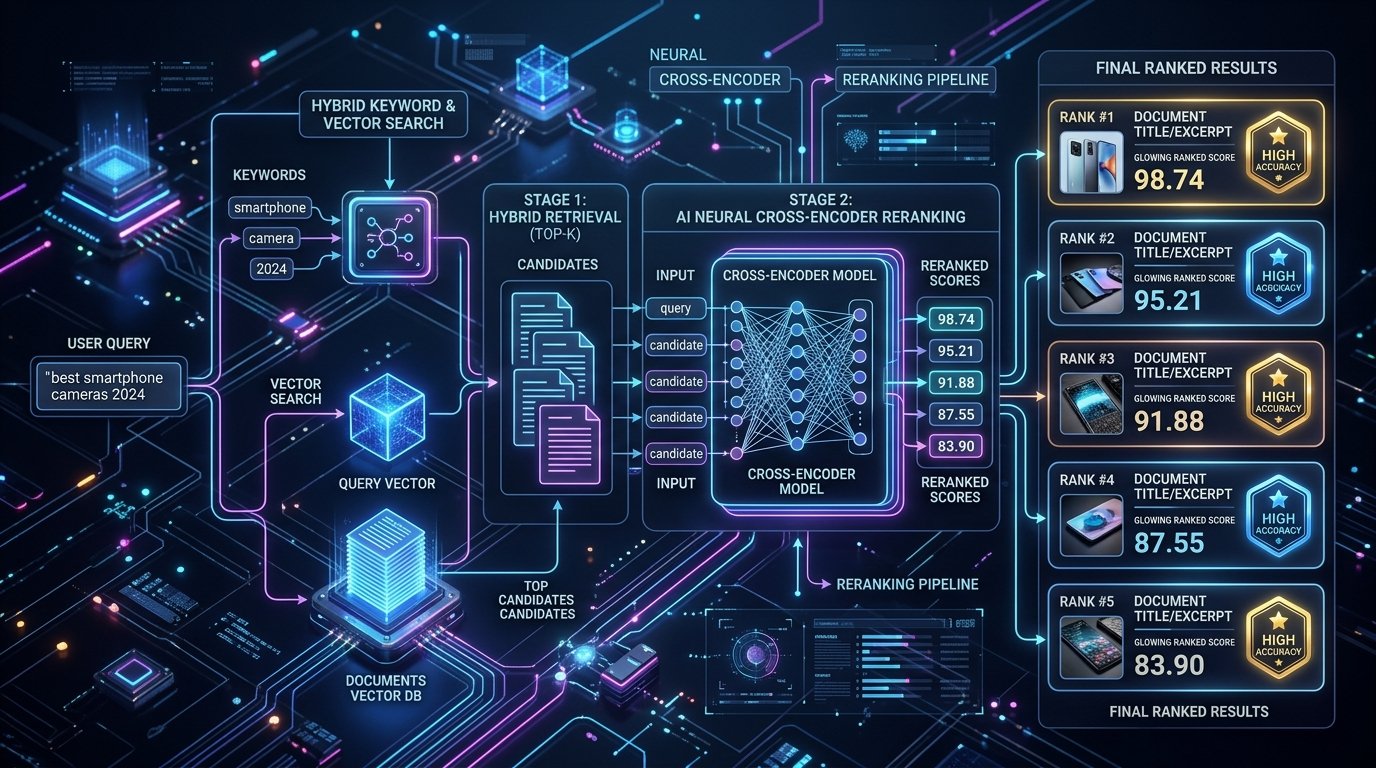
The Two-Stage Retrieval Architecture
Deploying a two-stage retrieval pipeline is the single highest-impact upgrade you can make to any production RAG application:
- Stage 1 (Broad Candidate Retrieval): Retrieve the top 30–50 candidate chunks quickly using vector search or hybrid retrieval.
- Stage 2 (Cross-Encoder Reranking): Pass the query and candidates through a specialized neural reranker (such as
Cohere Rerank v3orbge-reranker-large) to compute full cross-attention scores, filtering down to the absolute top 3–5 most relevant passages.
Benchmark Impact: Adding a cross-encoder reranking step typically boosts top-3 retrieval accuracy by 25% to 40% while drastically cutting LLM token input costs.
4. Relying Exclusively on Vector Search (Ignoring Hybrid Search & BM25)
Dense vector search excels at conceptual similarity (matching “how to terminate a lease” to “rental agreement cancellation”). However, vector search is notoriously unreliable when queries require exact string matches, such as:
- Product SKUs and serial numbers (e.g.,
HP-P01-PRO) - Error codes (e.g.,
ERR_CONNECTION_TIMED_OUT) - Specific function names or API endpoints (e.g.,
wp_get_site_info())
The Fix: Hybrid Search with Reciprocal Rank Fusion (RRF)
Combine sparse lexical search (BM25 / Full-Text) with dense semantic search (Vector Embeddings). Use Reciprocal Rank Fusion (RRF) to merge both ranked lists into a unified score:
# Reciprocal Rank Fusion Scoring Formula
RRF_Score(d) = Σ [ 1 / (k + rank_dense(d)) ] + Σ [ 1 / (k + rank_sparse(d)) ]
# Where k is typically set to 60 to smooth rank variances
5. Neglecting Document Preprocessing & Metadata Filtering
Garbage in, garbage out. If your parser ingests messy raw PDFs with navigation headers, page numbers, duplicate disclaimers, or mangled tables, those artifacts pollute your vector space.
Metadata Enrichment Best Practices
- Contextual Chunk Headers: Prepend document titles, section breadcrumbs, and date stamps to the beginning of every chunk before embedding (e.g.,
[Doc: Q3 Financial Report > Section: APAC Revenue]). - Structured Filtering: Attach metadata fields (like
author,date_created,product_version,tenant_id) to enable pre-filtering before vector distance calculation. - Clean Table Extraction: Convert complex tabular data into clean Markdown or HTML table structures rather than flattening them into unreadable plain text.
6. Overloading Context Windows (“Lost in the Middle”)
Modern LLMs feature context windows of 128k to 1M+ tokens, leading some engineers to retrieve 30+ chunks and dump them all into the system prompt. Research by Liu et al. (Stanford University) demonstrates that LLMs suffer from severe performance degradation when critical information is placed in the middle of long prompts.
How to Structure Context for Maximum Attention
- Limit Top-K: Send only 3 to 5 hyper-relevant, reranked chunks to the LLM.
- Bookend Critical Information: Place the user’s immediate question and the highest-scoring passage at the beginning and very end of the prompt context.
- Contextual Compression: Use an extractive LLM step to compress retrieved chunks down to only the exact sentences that answer the query before final generation.
7. Flying Blind: Zero Automated Evaluation & Observability
If your team evaluates RAG quality by manually typing 5 test queries into a chat interface before deploying, you are flying completely blind. A prompt change that improves query A can silently degrade queries B, C, and D.
Deploying an Evaluation Framework (RAG Triad)
Automate testing using frameworks like RAGAS, TruLens, or DeepEval to track core metrics continuously:
| Evaluation Metric | What It Measures | Target Score |
|---|---|---|
| Faithfulness | Is the generated answer grounded strictly in the retrieved context without hallucinations? | > 0.92 |
| Answer Relevancy | Does the generated response directly answer the user’s query without extraneous fluff? | > 0.90 |
| Context Precision | Are all retrieved chunks genuinely relevant to answering the question? | > 0.85 |
| Context Recall | Did the retrieval step successfully capture all required facts from the source knowledge base? | > 0.88 |
Build a Golden Evaluation Dataset containing 50 to 100 representative question-and-answer pairs, and integrate automated evaluation into your continuous deployment pipeline to catch regressions before they impact users.
Summary: The Production RAG Checklist
Transforming an unstable RAG prototype into an enterprise-grade retrieval engine comes down to deliberate architectural discipline:
- ✅ Chunk Size: Tuned for your specific document type with 15–20% boundary overlap.
- ✅ Hybrid Search: Combining BM25 keyword matching with dense vector embeddings via RRF.
- ✅ Neural Reranking: Two-stage retrieval filtering 50 candidate chunks down to the top 3–5.
- ✅ Metadata Enrichment: Document titles and category headers embedded into chunk payloads.
- ✅ Automated Observability: Continuous regression testing against the RAG Triad metrics.
Start by auditing your pipeline against these seven failure points. Adding a reranker and enabling hybrid search can be accomplished in an afternoon and will immediately eliminate over 80% of common retrieval failures.
Related & Suggested Stories

Nvidia’s $13 Billion Hugging Face Deal: What It Means for AI Developers

I Hate Editing Videos—These 6 AI Tools Do It for Me
